
Reality capture on construction sites: what it is, and when it pays for itself
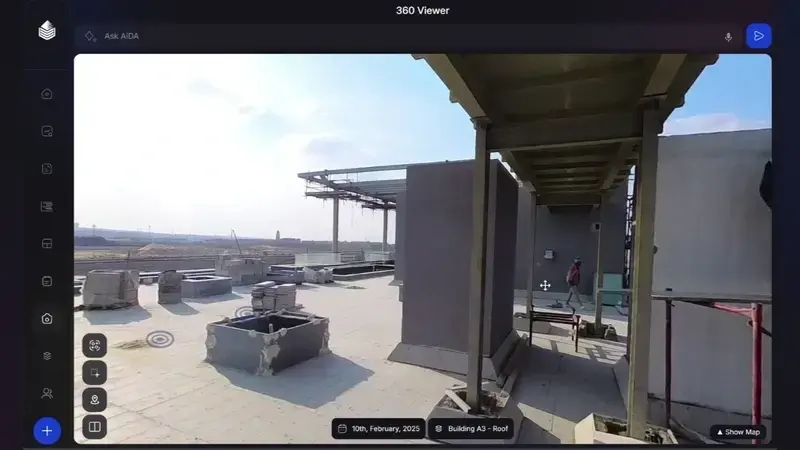
Reality capture is the unglamorous name for a simple idea: record what a construction site actually looks like, completely and regularly, so that nobody has to argue from memory later.
In practice, on most building projects, it means one person walking the site with a 360° camera (usually mounted on a hardhat) on a fixed route, once or twice a week. Software does the rest: it pins every frame to its position on the floor plan, aligns this week’s walk with last week’s, and turns a pile of video into something you can navigate like a map with a time slider.
What you get out of it
The output is a complete visual record of the works: every frame dated and located on the floor plan. A camera roll cannot do that, and the difference matters in three concrete situations:
1. Remote progress reviews. If your projects are an hour or a flight away from the people accountable for them, the capture record replaces most routine visits. You stand in any room on any date from a browser. The site visit becomes something you do to make decisions, not to find out what happened.
2. Payment applications and claims. A percent-complete figure with no evidence behind it is an invitation to negotiate. A figure tied to imagery of the claimed work (dated, positioned on plan) is much harder to argue with, in either direction. The same record settles variation-order disputes without excavating anyone’s WhatsApp history.
3. What gets covered up. Waterproofing, insulation, embedded conduits, reinforcement: the most expensive arguments in construction are about work nobody can see anymore. A weekly capture regime photographs everything before it disappears behind blockwork and screed, for the cost of a walk.
What it costs in site time
The honest answer: a 20,000 m² floor plate takes roughly a 30 to 45 minute walk. On a weekly cadence, that’s one junior engineer, half a morning, per building. Everything else (alignment, comparison, AI progress measurement) is compute, not site labour.
When it doesn’t pay
Small, fast, single-trade jobs with the decision-makers permanently on site get limited value from systematic capture; the site manager’s eyes are already the record. The economics turn decisively once any of these are true: the owner is remote, more than one package is running in parallel, or the contract makes progress evidence a payment condition.
Where AI changes the equation
Capture alone is an archive. The step-change is what machines do with it: reading work surfaces from imagery, measuring what was installed between two dates, and reconciling that against the programme, so progress reporting becomes something you audit rather than something you assemble. That is the part of the stack Oblix builds, and it’s the subject of the next article in this series.