
Progress you can prove: capture records in payment applications and claims
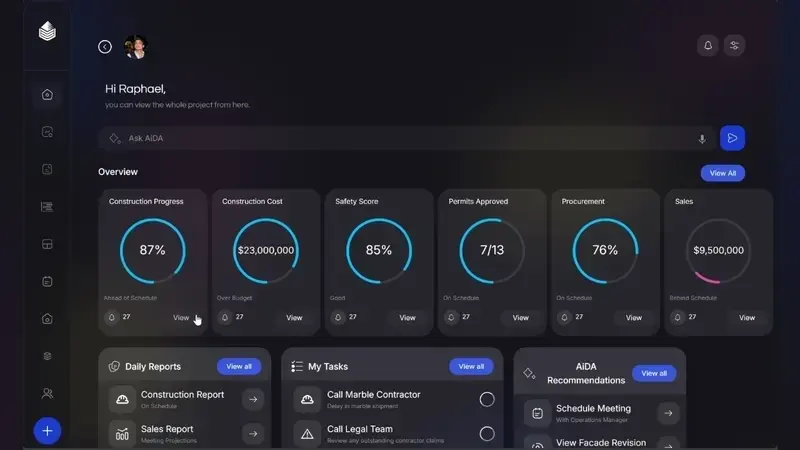
Every month, on every sizeable building project, the same ritual: the contractor submits a payment application, the consultant walks the site with a marked-up drawing, and the two sides negotiate the distance between a claimed percentage and an observed one. The instrument of record is, frequently, someone’s phone camera roll.
Swap that camera roll for a systematic capture regime, and the monthly ritual changes shape.
Percent-complete becomes a measurement
When a site is captured on a fixed weekly route, the question “how much of the third-floor blockwork is done?” stops being answered with a number typed into a spreadsheet. It’s answered with imagery of the third floor, dated and positioned on the plan. Add AI segmentation on top and you get quantities measured straight from that imagery. The consultant’s job shifts from estimating progress to auditing a stated figure against its evidence. Reviews get shorter and less adversarial, because disagreement now needs a reason.
The payment cycle compresses
The slow part of certification is rarely arithmetic; it’s verification. When the evidence for each line item is one click away from the claimed quantity, consultants certify with less site time and fewer round trips. Contractors who adopted systematic capture report earlier submission and faster certification of payment applications. The record removes the “we’ll confirm on the next visit” delay loop.
Claims stop depending on memory
Delay and disruption claims are won and lost on contemporaneous records. Six months after the fact, the question “when did the ceiling closures actually start in zone B?” is unanswerable from meeting minutes but instantly answerable from a capture archive with a time slider. The same applies in the other direction: an owner reviewing a claim can test its story against what the site actually showed, week by week.
None of this requires anticipating a dispute. That is precisely the point of a systematic regime: the record exists because it always exists, which is what makes it credible when it matters.
What to put in the contract
Teams getting the most out of capture tend to write it into the project’s mechanics rather than treating it as an owner’s surveillance tool:
- A named cadence and route: weekly at minimum, every active area, timed before major cover-ups.
- Shared access, so owner, consultant and contractor read the same record. Asymmetric access breeds parallel truths.
- A reference in the payment procedure, so percent-complete claims are reviewed against the capture record by default.
Where this is heading
The manual version of this workflow already pays for itself. The compounding value arrives when progress measurement is automated against the record: planned versus actual, elevation by elevation, generated rather than compiled. If you want to see what that looks like on a live project, that’s what our demo shows.